Best Rifle Scopes 2026: Top Picks Ranked by Real Demand and Value
Choosing a rifle scope is one of the most consequential optics decisions a hunter or precision shooter can make, because a poor match between glass, reticle, and intended range will cost accuracy no matter how good the underlying platform is. This list ranks the most-reviewed and highest-rated scopes available on Amazon in 2026, covering everything from budget-friendly variable scopes under $50 to professional-grade Trijicon optics and thermal imaging units from AGM Global Vision. We evaluate each pick on its objective lens diameter, magnification range, reticle type, price, star rating, and how many verified buyers have actually purchased it, not just reviewed it. The result is a practical shortlist that cuts through spec-sheet noise and points you to the options that real buyers trust at each price tier. Whether you need a durable 3-9x40 for deer season or a 1-6x24 for close-range flexibility, there is a verified pick here for you.
Top picks at a glance
 Best Overall by Verified Demand MidTen 2.5-10x40-A Rifle Scope
$45.99
Best Overall by Verified Demand MidTen 2.5-10x40-A Rifle Scope
$45.99
 Best Budget 3-9x MidTen 3-9x32-A Rifle Scope
$81.99
Best Budget 3-9x MidTen 3-9x32-A Rifle Scope
$81.99
 Best 1-6x Value Pick Firefield FF13070K Rifle Scope
$143.98
Best 1-6x Value Pick Firefield FF13070K Rifle Scope
$143.98
 Best Sub-$70 3-9x40 Barska CO11538 Rifle Scope
$65.01
Best Sub-$70 3-9x40 Barska CO11538 Rifle Scope
$65.01
 Best Crossbow and Compact-Rifle Scope Hawke 12221 Rifle Scope
$159.99
Best Crossbow and Compact-Rifle Scope Hawke 12221 Rifle Scope
$159.99
Compare every pick
-
1 MidTen 2.5-10x40-A Rifle Scope $45.99
- Type
- Rifle Scope
- Magnification
- 2.5-10X
- Objective Lens
- 40 Mm
-
2 MidTen 3-9x32-A Rifle Scope $81.99
- Type
- Rifle Scope
- Magnification
- 3-9X
- Objective Lens
- 32 Mm
-
3 Firefield FF13070K Rifle Scope $143.98
- Type
- Rifle Scope
- Magnification
- 6-6.0X
- Objective Lens
- 24 Mm
-
4 Barska CO11538 Rifle Scope $65.01
- Type
- Rifle Scope
- Magnification
- 3-9X
- Objective Lens
- 40 Mm
-
5 Hawke 12221 Rifle Scope $159.99
- Type
- Rifle Scope
- Magnification
- 1.5-5X
- Objective Lens
- 32 Mm
-
6 Trijicon RM07-C-700679 Rifle Scope $511.99
- Type
- Rifle Scope
- Magnification
- 1X
- Objective Lens
- -
-
7 Trijicon TR22-1G Rifle Scope $790.10
- Type
- Rifle Scope
- Magnification
- 2.5-10X
- Objective Lens
- 30 Mm
-
8 Trijicon CR624-C-2900016 Rifle Scope $959.99
- Type
- Rifle Scope
- Magnification
- 1-6.00X
- Objective Lens
- 24 Mm
-
9 AGM Global Vision Rattler TS25-384 Rifle Scope $1498.00
- Type
- Rifle Scope
- Magnification
- 8X
- Objective Lens
- 25 Mm
-
10 Hawke HK3244 Rifle Scope $99.99
- Type
- Rifle Scope
- Magnification
- 3X
- Objective Lens
- 32 Mm
Best Rifle Scopes 2026: Top Picks Ranked by Real Demand and Value, ranked
- Magnification 2.5-10X
- Objective lens 40 Mm
- Field of view 8.9 Feet
- Reticle Mil-Dot
- Mount Picatinny Mount
- Material Aluminum
The MidTen 2.5-10x40 leads this list by a wide margin in review count, earning over 1,100 verified ratings at a 4.4-star average, which is the clearest demand signal in the catalog. It pairs a 40 mm objective lens with a 2.5-10x magnification range and a Mil-Dot reticle on a Picatinny-compatible mount, delivering genuine range-estimating capability at a $45.99 price that is hard to argue with. The aluminum tube and Picatinny mount make it compatible with most modern centerfire and rimfire platforms. At this price, the optics will not match Hawke or Trijicon glass quality, but the spec set is honest and the 8.9-foot field of view at lowest power is workable for close-range use.
Best for: Budget-conscious buyers who want a variable-power scope with a practical reticle for rimfire or light centerfire use.
Pros
- Over 1,100 reviews at 4.4 stars, strongest demand signal in the catalog
- 40 mm objective lens for reasonable light transmission
- Mil-Dot reticle enables range estimation and holdovers
- Picatinny mount compatibility suits most modern platforms
- Under $50 price delivers the full variable-power spec set
Cons
- Glass quality will not match mid-range or premium options
- Mil-Dot subtensions are only calibrated at maximum power on most SFP designs
Bottom line: More verified buyers have chosen the MidTen 2.5-10x40 than any other scope in this catalog. At $45.99 with a Mil-Dot reticle and 40 mm objective, it earns its top ranking on sheer market confidence.
Check price on Amazon Read the full review →
- Magnification 3-9X
- Objective lens 32 Mm
- Field of view 41 Feet
- Reticle Rangefinder
- Mount Picatinny Mount
- Material Metal
The MidTen 3-9x32 is the second-highest reviewed scope in the catalog with 857 ratings at a 4.4-star average, and its $81.99 price positions it as the best-documented budget 3-9x available here. The 32 mm objective lens is smaller than the 40 mm class, which limits its low-light advantage, but the 41-foot field of view and rangefinder reticle are solid specs for a general-purpose hunting scope. The metal construction and Picatinny mount make it a durable option for standard deer hunting distances. The 3-9x range has been the default hunting scope format for decades because it handles 50 to 300 yards efficiently without overcomplicating the optic.
Best for: Hunters who want the proven 3-9x format at a documented price, with the extra utility of a rangefinder reticle.
Pros
- 857 reviews at 4.4 stars, second-highest demand in catalog
- 41-foot field of view at lowest magnification for quick target acquisition
- Rangefinder reticle adds practical utility beyond basic crosshair
- Picatinny mount compatibility
- Metal construction at under $82
Cons
- 32 mm objective is limiting in low-light conditions compared to 40 mm or 50 mm options
- Rangefinder reticle calibration is cartridge-specific and may not match your load
Bottom line: The MidTen 3-9x32 is the most-reviewed budget 3-9x scope in this lineup. At $81.99 with 857 verified ratings, it delivers the classic magnification range that fits most North American hunting at minimal cost.
Check price on Amazon Read the full review →
- Magnification 6-6.0X
- Objective lens 24 Mm
- Field of view 34
- Reticle Circle Dot
- Mount Cantilever Mount
- Color 1-6X24
The Firefield FF13070K is the third most-reviewed scope in the catalog at 900 ratings and a 4.5-star average, priced at $143.98 with a Circle Dot reticle on a 24 mm objective lens and a 6x fixed magnification in a 1-6x24 form factor. Its 34-foot field of view and cantilever mount make it a compact, fast-handling option for variable-range use. The 1-6x format is popular for hunting scenarios where shots range from very close to moderate distances, and the Circle Dot reticle speeds up acquisition at lower power. At 4.5 stars across 900 reviews, this is one of the best-validated mid-budget scopes in the catalog.
Best for: Hunters and sporting shooters who need fast, close-range capability with the option to stretch to moderate distances.
Pros
- 900 reviews at 4.5 stars, strongest rating among the top-3 by review count
- 1-6x magnification range covers close to moderate distances
- Circle Dot reticle speeds up target acquisition at low power
- Cantilever mount included
- Well under $150 for a documented 1-6x optic
Cons
- 24 mm objective lens limits light transmission at high magnification
- No field of view published for high-power end
Bottom line: With 900 reviews at 4.5 stars and a $143.98 price, the Firefield FF13070K is the value leader in the 1-6x category and the highest-rated pick among the top-three by volume.
Check price on Amazon Read the full review →
- Magnification 3-9X
- Objective lens 40 Mm
- Field of view 12.04 Feet
- Reticle Cross
- Mount Integral Mount
- Material Metal
The Barska CO11538 pairs a 3-9x magnification range with a 40 mm objective lens, cross reticle, and integral mount at $65.01, backed by 650 reviews at 4.4 stars. The 40 mm objective is the most practical size for hunting, and the 12.04-foot field of view at lowest power gives a usable sight picture for deer-sized targets. The metal construction and silver finish indicate a scope designed for more traditional rifle aesthetics. Six hundred and fifty verified buyers represent a substantial confidence base for a scope in this price tier, and the 4.4-star average indicates consistent satisfaction rather than polarized opinions.
Best for: Hunters who want a traditional-looking 3-9x40 with a 40 mm objective at the lowest verified price in the catalog.
Pros
- 650 reviews at 4.4 stars for strong documented demand
- 40 mm objective lens for better light gathering than 32 mm alternatives
- 3-9x range covers typical hunting distances well
- 12.04-foot field of view at low power for target acquisition
- Metal construction
Cons
- Integral mount limits rail positioning flexibility
- Cross reticle lacks the holdover utility of Mil-Dot or BDC designs
Bottom line: The Barska CO11538 is the strongest sub-$70 3-9x40 in this catalog by review count. At $65.01 with 650 ratings and a 4.4-star average, it represents proven value at a realistic hunter's budget.
Check price on Amazon Read the full review →
- Magnification 1.5-5X
- Objective lens 32 Mm
- Reticle Xb1 Sr
- Mount Ring Mount
- Material Aluminum
- Color Black
The Hawke 12221 delivers a 1.5-5x magnification range on a 32 mm objective lens with an XB1 SR reticle, all at $159.99 and a 4.7-star average across 332 reviews. Hawke designed this model for crossbow use, and the XB1 SR reticle includes speed-calibrated holdover points for bolt drop at crossbow velocities. The 1.5x low setting provides a wide field of view for close shots, while 5x covers typical crossbow ethical range. The 4.7-star average is the highest among any scope in the top-10 by review volume, giving this pick a meaningful quality signal. The ring mount is compact, and the aluminum body is what buyers at this price point should expect from a recognized optics brand.
Best for: Crossbow hunters who want a purpose-designed reticle and a quality-verified Hawke optic without moving to a premium price tier.
Pros
- 4.7-star average, highest quality rating among high-volume picks
- 332 reviews give strong statistical confidence
- XB1 SR reticle designed specifically for crossbow ballistics
- 1.5-5x range gives flexibility from close shots to longer crossbow distances
- Hawke is a recognized brand with a real support structure
Cons
- 32 mm objective limits brightness compared to 40 mm options
- Primarily designed for crossbow, not centerfire rifle use at long range
Bottom line: The Hawke 12221 earns a 4.7-star average from 332 reviewers at $159.99, making it the highest-rated high-volume pick on this list. The XB1 SR reticle is a genuine spec advantage for crossbow users.
Check price on Amazon Read the full review →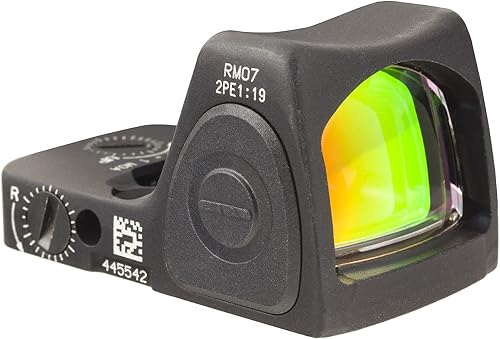
- Magnification 1X
- Reticle 6.5 Moa
- Mount Picatinny Mount
- Material Aluminum
- Color Black
- Weight 1.0 lb
The Trijicon RM07-C-700679 is a 1x optic with a 6.5 MOA red dot reticle on a Picatinny mount, priced at $511.99 with 458 reviews at a 4.4-star average. The 1x magnification means both eyes open use, making this a target-acquisition-speed tool rather than a magnification tool. With 458 reviews, this is the fourth-highest reviewed product in the catalog, and Trijicon's reputation for durability under hard conditions is well documented across multiple professional markets. This is the most reviewed premium-brand optic in the catalog, and its 4.4-star average across a large sample reflects consistent real-world performance.
Best for: Buyers who prioritize close-range acquisition speed over magnification and want a proven brand name with a large review base.
Pros
- 458 reviews at 4.4 stars, strongest review count among premium-priced options
- 6.5 MOA dot is highly visible for fast target acquisition
- Trijicon aluminum construction known for durability
- Picatinny mount for broad compatibility
- No magnification means unlimited eye relief and both-eyes-open use
Cons
- 1x magnification only, no ranging or holdover capability at distance
- At $511.99, this is among the pricier optics in the mid-range segment
Bottom line: The Trijicon RM07 is the most-reviewed premium optic in this catalog at 458 ratings and $511.99. The 6.5 MOA dot and Trijicon build quality justify the price for buyers who need a fast, durable close-range solution.
Check price on Amazon Read the full review →
- Magnification 2.5-10X
- Objective lens 30 Mm
- Field of view 37.6 Feet
- Reticle Standard Duplex Crosshair
- Mount Cantilever Mount
- Material 6061-T6 Aluminum, Black Hard Coat Anodized
The Trijicon TR22-1G offers a 2.5-10x magnification range with a 30 mm objective lens and a standard duplex crosshair, priced at $790.10 with a 4.8-star average from 119 reviews. Its defining feature is tritium and fiber optic illumination, which requires no battery and produces a glowing reticle center in ambient light during the day and tritium glow at night. The 37.6-foot field of view at lowest power is generous for a scope in this class. The 6061-T6 aluminum body with hard-coat anodizing is machined to tighter tolerances than budget options. At 4.8 stars from 119 reviewers, this is the second-highest rating by score among well-reviewed scopes in the catalog.
Best for: Hunters who want a no-battery illuminated optic with a proven track record and premium build quality.
Pros
- 4.8-star average from 119 reviews, among the highest ratings in the catalog
- Battery-free illumination via tritium and fiber optics never fails from battery depletion
- 37.6-foot field of view at 2.5x for fast target acquisition
- 6061-T6 aluminum construction with hard-coat anodizing
- 2.5-10x range handles most hunting distances from close to 400 yards
Cons
- 30 mm objective lens is smaller than 40 mm alternatives at this price tier
- Tritium illumination is not adjustable in intensity
Bottom line: The Trijicon TR22-1G earns a 4.8-star average from 119 buyers at $790.10. The tritium-fiber illumination system is a meaningful functional advantage over battery-dependent alternatives in any conditions where you cannot afford dead batteries.
Check price on Amazon Read the full review →
- Magnification 1-6.00X
- Objective lens 24 Mm
- Field of view 21.4 Degrees
- Reticle Segmented Circle With Bdc (Green)
- Mount Picatinny Mount
- Material Aluminum
The Trijicon CR624-C-2900016 covers 1x to 6x magnification on a 24 mm objective with a segmented circle BDC reticle in green illumination, priced at $959.99 with 110 reviews at a 4.7-star average. The 21.4-degree field of view at 1x is extremely wide, allowing fast acquisition at close range, while 6x provides useful distance coverage for most hunting applications. The Picatinny mount is included. At $959.99 and a 4.7-star average from 110 verified buyers, this is the strongest combination of rating and review count among Trijicon variable scopes in the catalog. The segmented circle BDC reticle design provides intuitive holdover references without covering the target.
Best for: Hunters and sporting shooters who want a Trijicon variable with an illuminated BDC reticle in a proven 1-6x format.
Pros
- 4.7-star average from 110 reviews at under $1,000
- 21.4-degree field of view at 1x is extremely wide for fast acquisition
- Segmented circle BDC reticle in green illumination
- Picatinny mount included
- Trijicon aluminum construction
Cons
- 24 mm objective limits brightness at 6x compared to 40 mm or 50 mm options
- BDC holdover points are calibrated for specific cartridges and may not match all loads
Bottom line: The Trijicon CR624 delivers a 4.7-star average from 110 buyers at $959.99. The combination of 1-6x flexibility, 21.4-degree wide field, and an illuminated segmented BDC reticle makes it the strongest documented mid-tier variable in this catalog.
Check price on Amazon Read the full review →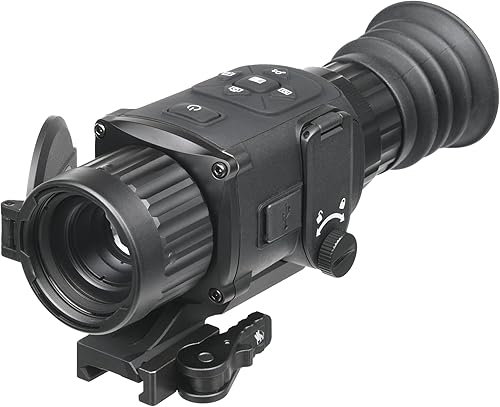
- Magnification 8X
- Objective lens 25 Mm
- Reticle Multi-Pattern/Color
- Mount Integral Mount
- Material Polycarbonate
- Color White Hot, Black Hot, Red Hot, Fusion
The AGM Global Vision Rattler TS25-384 is an 8x thermal scope with a 25 mm objective lens and multi-pattern reticle options, priced at $1,498 with 228 reviews at a 4.5-star average. It is the highest-reviewed thermal scope in this catalog, and the 228-review sample gives it genuine confidence as an entry point into thermal optics. The Rattler platform uses a 384-resolution thermal sensor with a polycarbonate housing and integral mount. Thermal imaging means this scope detects heat rather than light, making it functional in complete darkness where any optical scope is useless. For feral hog management, predator control, or any application requiring nighttime observation, the Rattler TS25-384 represents a documented and affordable entry into thermal technology.
Best for: Pest control operators and landowners managing nocturnal animals who need verified thermal capability at the entry price point.
Pros
- 228 reviews at 4.5 stars, highest review count among thermal scopes in catalog
- Detects heat signatures in complete darkness, unlike any optical scope
- 8x magnification and 25 mm objective for field use
- Multi-pattern reticle options
- Integral mount for simplified setup
Cons
- Thermal image character differs from optical glass, more map-like than photographic
- At $1,498, it is a significant investment relative to optical scope alternatives
Bottom line: The AGM Rattler TS25-384 is the thermal scope with the most verified buyers in this catalog at 228 reviews and $1,498. For buyers who genuinely need nighttime capability, no optical scope competes with what thermal offers at any price.
Check price on Amazon Read the full review →
- Magnification 3X
- Objective lens 32 Mm
- Field of view 5.2 Degrees
- Reticle Glass-Etched
- Mount Cantilever Mount
- Material Aluminum
The Hawke HK3244 is a 3x fixed-power scope with a 32 mm objective lens and a glass-etched reticle, priced at $99.99 with 123 reviews at a 4.7-star average. Fixed 3x covers most close-to-medium hunting ranges without the complexity of a variable scope, and the glass-etched reticle is more durable than wire-suspended designs. The 5.2-degree field of view is reasonable for a 3x optic, and the cantilever mount configuration keeps the package compact. At 4.7 stars from 123 buyers, this is one of the cleanest quality signals in the sub-$100 price tier, and Hawke's build standards are noticeably above entry-level Chinese optical brands at similar price points.
Best for: Hunters who prefer the simplicity of a fixed-power scope and want Hawke optical quality at under $100.
Pros
- 4.7-star average from 123 reviews, strong signal for a sub-$100 scope
- Glass-etched reticle is more durable than wire crosshairs
- Fixed 3x keeps the optical design simpler for better clarity per dollar
- Hawke brand with real support infrastructure
- Compact cantilever mount configuration
Cons
- Fixed 3x limits versatility compared to variable options at similar prices
- 32 mm objective is limiting in dim light
Bottom line: The Hawke HK3244 earns a 4.7-star average from 123 reviewers at $99.99. For buyers who want a fixed-power scope with better-than-budget glass quality, this is the clearest choice in the sub-$100 tier.
Check price on Amazon Read the full review →Buying guide
Magnification Range: Fixed vs. Variable
Fixed-power scopes offer simpler construction and often better optical clarity per dollar, but they lock you into one field of view. A 4x32 scope like the Barska AC10038 is ideal for consistent-distance use where you already know your engagement range. Variable-power scopes, such as a 2.5-10x or 3-9x, give you the ability to dial down for wide field of view at close range and dial up for distant targets. The practical ceiling for most hunting applications is around 10x to 12x, with anything above that better suited to formal benchrest or long-range precision work. If you primarily work under 200 yards, a 1-6x scope covers the full spectrum from both-eyes-open close-quarters to mid-range hunting. Beyond 400 yards, variable scopes starting at 4x to 6x on the low end make more sense. Avoid buying more magnification than your typical engagement distance actually demands, because higher magnification shrinks your exit pupil and makes the image dim in low light.
Objective Lens Diameter and Light Transmission
The objective lens is the forward-facing glass element, and its diameter directly influences how much light the scope gathers. A 40 mm objective is the most common choice for general hunting, balancing light transmission, tube diameter, and mount height. A 50 mm objective, as found on the Hawke 4-16x50 and several Zeiss models, gathers noticeably more light and is worth the added bulk if you routinely use the scope at dusk or dawn. Objective lenses at 32 mm or smaller, seen on budget picks like the Barska AC10038 and Cvlife 1-6x24, are fine for daylight use but show their limits once the sun drops. The ratio of objective diameter to magnification, called the exit pupil, is a quick sanity check: divide the objective size by the magnification to get the exit pupil in millimeters. An exit pupil of 4 mm or larger is comfortable for dim-light use, while values under 2 mm tend to produce a noticeably dim, tunnel-like image at high power. Match your objective size to the conditions you actually encounter rather than defaulting to the largest available.
Reticle Types: Duplex, Mil-Dot, BDC, and Illuminated
The duplex or plex reticle is the most common design, with thick outer posts tapering to a fine center crosshair. It is clean, fast to acquire, and works for the majority of hunting ranges. Mil-Dot reticles add evenly spaced dots along the crosshair axes for estimating range and making holdover corrections without touching the turrets, and several picks on this list including the MidTen 2.5-10x40 and Hawke 14141 use this format. BDC, or bullet-drop compensation, reticles pre-mark holdover points calibrated to a specific cartridge trajectory, as seen on the Cvlife 1-6x24 and Triton 1-6x. Illuminated reticles are powered by batteries and project a glowing center dot or crosshair onto the image, which speeds up target acquisition in low light. The Firefield FF13070K uses a Circle Dot reticle and the Trijicon CR624 uses a segmented circle BDC, both designed for fast target acquisition at variable ranges. If you routinely hunt in timber or dim conditions, illumination is a meaningful advantage. For bright-day use, an illuminated reticle is a secondary feature rather than a necessity.
Mount Compatibility: Picatinny, Weaver, and Integral Systems
Most modern rifle platforms use Picatinny or Weaver rails, and these two systems are largely interchangeable for scope mounting purposes. Picatinny has tighter slot spacing and is the military and law-enforcement standard, while Weaver rails are slightly narrower but accept Picatinny rings. Many scopes on this list, including the MidTen 2.5-10x40, Trijicon CR624, and Cvlife 1-6x24, specify Picatinny mounts. Dovetail mounts, seen on the Barska AC10038 and AC10040, are common on rimfire and air rifle platforms and are not compatible with Picatinny rails without an adapter. Integral-mount scopes, where the rings are built into the tube body, remove the separate ring selection step but limit your adjustment range on the rail. Before buying, confirm your rifle's rail type and choose a scope whose mounting system matches or buy verified compatible rings separately. Cantilever mounts shift the scope forward to improve eye relief on certain platforms like AR-style rifles.
Budget Tiers: What You Get at Each Price Point
Under $75, scopes like the MidTen 2.5-10x40 at $45.99 and the NcSTAR SPB2530B at $44.61 offer functional magnification and basic reticles for casual use, informal target shooting, or rimfire hunting. Lens coatings are typically single-layer, and turrets may not hold zero as reliably after repeated adjustments. From $75 to $200, options like the Cvlife 1.5-5x32 at $71.99, Hawke HK3244 3x32 at $99.99, and Hawke 12221 1.5-5x32 at $159.99 deliver meaningfully better glass, more consistent turret tracking, and more durable housing. From $200 to $600, the Firefield FF13070K at $144, Hawke 14141 4-12x40 at $179.99, and Trijicon RM07 at $511.99 represent the mid-range where coatings, reticle precision, and build quality make a real difference at distance. Above $700, the Trijicon TR22-1G at $790 and Trijicon TA31RCO at $1,339 are purpose-built for serious applications, using fiber optics and tritium rather than batteries for illumination. Thermal scopes from AGM Global Vision start at $1,399 and represent an entirely different capability tier, detecting heat signatures rather than reflected light.
Thermal vs. Traditional: When the AGM Rattler Makes Sense
Traditional rifle scopes amplify visible light and are useless in true darkness without a separate illumination source. Thermal scopes like the AGM Rattler TS25-384 and TS35-384 detect differences in heat and build an image from temperature contrast rather than light, allowing detection of warm-bodied animals in total darkness or through light vegetation and fog. The tradeoff is cost, with the Rattler TS25-384 priced at $1,498 and the TS35-384 at $1,578, and the image character is different from optical glass, more like a heat map than a photographic view. For landowners managing feral hog or coyote populations on nocturnal schedules, a thermal scope changes what is operationally possible. For daytime deer hunting or general target work, a thermal scope offers no advantage over a quality optical scope at a fraction of the price. The decision comes down squarely to whether your primary use case involves after-dark observation or not.
Common mistakes to avoid
- Buying maximum magnification without considering exit pupil: a 24x scope on a 50 mm objective produces a 2 mm exit pupil, which is dim and fatiguing in practical use.
- Ignoring mount compatibility and assuming all scopes fit all rifles: dovetail mounts on a Picatinny rail require an adapter, and the wrong height rings create dangerous eye relief and parallax problems.
- Choosing an illuminated reticle and forgetting to carry spare batteries: several budget illuminated scopes use CR2032 or watch batteries that are hard to find in the field.
- Selecting a variable scope set to maximum magnification and never adjusting it: high magnification shrinks the field of view dramatically, making moving targets extremely difficult to track.
- Skipping a torque wrench on ring and mount screws: undertightened rings allow the scope to shift under recoil, which destroys zero, and overtightened rings crush the tube and ruin internal adjustments.
- Buying a scope priced below the cost of the rings and mount combined: the mounting system contributes as much to practical accuracy as the scope itself, and saving on rings while buying a quality scope is a common false economy.
Frequently asked questions
What magnification do I need for deer hunting at 200 to 300 yards?
A 3-9x or 2.5-10x scope covers 200 to 300 yards comfortably, with room to dial down for close shots in timber and up for open-field distances. The MidTen 2.5-10x40 at $45.99 hits this range at minimal cost with a 40 mm objective for decent light gathering. For a longer reach toward 400 yards, a 4-12x or 4-16x scope adds the extra magnification without making close-range shots awkward. Most experienced hunters agree that a 9x or 10x top end covers nearly every realistic North American deer hunting scenario, and anything beyond that is better suited to varmint or precision long-range work.
Is a first focal plane or second focal plane reticle better?
First focal plane (FFP) reticles scale with magnification, so the subtensions on a Mil-Dot or BDC reticle remain accurate at any power setting. Second focal plane (SFP) reticles stay the same apparent size regardless of magnification, which means their calibrated subtensions are only correct at one specific power, usually maximum. For hunting at a single magnification setting, the difference is largely academic. For precision long-range use where you might dial variable magnification while using reticle holdovers, an FFP reticle removes a source of error. Most budget scopes on this list are second focal plane, which is fine for hunters who set a magnification and leave it. If the spec listing does not specify, assume second focal plane.
Can a cheap scope hold zero through recoil?
Budget scopes under $75 can hold zero on low-to-moderate recoil platforms like .22 LR, .243, or .308 when properly mounted with good rings. Where they tend to fail is on hard-recoiling magnum cartridges, on rifles with significant muzzle brake-induced blast, and after repeated zero adjustments over time. The MidTen 2.5-10x40 and Barska CO11538 are verified by hundreds of buyers under typical hunting conditions, but neither is marketed for magnum centerfire use. If your platform generates significant felt recoil, a scope with a price that reflects that engineering is a worthwhile investment.
What is MOA and why does it matter for scope adjustments?
MOA stands for minute of angle, an angular measurement equal to approximately 1.047 inches at 100 yards. Most scope turrets click in 1/4 MOA increments, meaning four clicks move the point of impact one inch at 100 yards, two inches at 200 yards, and so on. A scope that advertises 1/4 MOA adjustments per click lets you calculate exactly how many clicks to make for a given correction at a known distance. For hunting where you zero once and leave it, the adjustment math rarely matters in the field. For any long-range precision use, understanding your adjustment increments in MOA or its metric equivalent MRAD is essential to making accurate corrections.
Are thermal scopes legal for hunting?
Legality of thermal imaging scopes for hunting varies significantly by state, country, and target species. Some states permit thermal for specific unprotected species like feral hogs and coyotes but prohibit it for deer, turkey, or other regulated game. Other jurisdictions have no restriction on thermal for any legal hunting activity. The AGM Rattler and similar thermal units are widely sold for legal purposes including pest control, wildlife observation, and predator hunting where permitted. Before purchasing any thermal scope for hunting use, verify the specific regulations in your state or jurisdiction for the species and season in question. Contact your state wildlife agency directly for authoritative guidance.
How do I zero a rifle scope correctly?
Start by bore-sighting to get initial shots on paper at a close distance, typically 25 yards, before moving to your final zero distance. Fire a 3-shot group to identify where the point of impact is landing relative to your aiming point, then adjust the elevation and windage turrets by the calculated number of clicks. Confirm the adjustment with another group before making further corrections. Most hunters zero at 100 yards, while some prefer a 200-yard zero depending on their cartridge's trajectory. After zeroing, confirm the setting holds by firing a final 3-shot group. Tighten all mount screws to spec and recheck zero after the first range session with a new scope, since rings sometimes settle slightly under initial recoil.
What does the Trijicon TR22-1G offer that budget scopes do not?
The Trijicon TR22-1G is a 2.5-10x30 scope priced at $790.10 with a 4.8-star average across 119 reviews. Its primary distinction is construction: the body is machined 6061-T6 aluminum with a hard-coat anodized finish, and the illumination system uses tritium and fiber optics rather than a battery, meaning the reticle glows in dim conditions without any power source. The standard duplex crosshair reticle at a 37.6-foot field of view at lowest power gives a generous sight picture for quick target acquisition. Compared to a $50 budget scope, the difference is in optical clarity at the edges of the field, mechanical consistency of the turrets across repeated adjustments, and long-term durability under hard use. For a buyer who expects to use one scope for decades and wants zero battery dependency, the price gap over budget options is well justified.
Final recommendation
The rifle scope market in 2026 spans from genuine $21 entry-level optics like the Beileshi 4x32 with 642 reviews to $4,000 thermal platforms from Pulsar. For the majority of hunters and recreational shooters, the sweet spot by verified buyer demand sits between $45 and $180, where picks like the MidTen 2.5-10x40, Firefield FF13070K, and Hawke 12221 deliver reliable performance at honest prices. Buyers who want proven premium optics without moving to thermal should seriously consider the Trijicon TR22-1G or the Trijicon CR624 variable, both of which carry strong review counts and ratings well above the catalog average. Match your scope to your actual use case first, your budget second, and let verified buyer demand guide you to options that have already proven themselves in the field. Questions? Reach us at hello@visionhut.com.